Knowledge check with explanations

Meth Lab Cleanup quiz and study guide

Find out what you already understand, then read the parts you missed.

This 15-question quiz checks how well you understand the practical side of meth contamination in buildings. It is not a chemistry test. The questions cover what owners, landlords, and buyers really run into. You will learn what to do if you find lab gear, and why a police release does not mean a home is safe. You will learn why testing comes before tear-out, where samples should be taken, and why disinfecting is not the same as removing residue. You will also learn how to judge a company, what insurance may not cover, and what the rules often say about renting and selling. Are you about to hire a contractor or bargain on a flagged property? Then work through the study guide first. It will sharpen your conversations and help you spot promises that do not hold up.

Get an email reply about meth lab cleanup

Send a short message to the follow-up inbox. A coordinator can reply by email. This form does not send emergency help; call 911 first if anyone is in danger.

Tell us what you need help with. Share a short description; please leave out medical details, access codes, and other sensitive information.

A request does not confirm a booking. For immediate danger, contact local emergency services.

Or email info@methlabcleanup.online

Answer honestly instead of guessing what the site wants you to say. A wrong answer is useful. It points to an idea you should read more about before spending money. The explanation after each question links back to the related guide so you can go deeper. Nothing here replaces the written rules your state publishes. It does not replace a qualified inspector looking at your real building. Treat your score as a sign of how ready you are. A high score means you can ask better questions. It does not mean you can run a cleanup yourself. Come back after you talk with an inspector and see whether your answers change.

Meth Lab Cleanup knowledge check

15 questions about real meth lab cleanup situations: staying safe, what happens, cost, choosing help and the rules. Every answer comes with a short explanation.

Why this quiz matters

Knowing these basics makes it easier to spot bad advice and ask a company the right questions. This quiz is educational — it does not certify anyone. After the quiz, review the explanations for questions you missed. For professional guidance on your specific situation, use the contact form at the top of the page for an email reply. Meth Lab Cleanup is classified as extreme-risk — every question here relates to real hazards where professional remediation is essential.

Progress1 / 15
SafetyQ1

You walk into a rental and find tubing, jars, and cooking gear that look like they might still be in use. What should you do?

Study guide: the six ideas behind the questions

Read these before or after the quiz. They cover the concepts every question draws on, written for meth lab cleanup specifically.

1Recognizing a lab or heavy-use property

Making meth leaves clues that ordinary cleaning does not remove. Look for yellow, brown, or rust-colored stains on walls and ceilings. Look for chemical smells that stay after airing out and for corroded plumbing fixtures. Watch for changes like sealed or rerouted vents. Strong signs include thrown-out glassware, tubing, cold packs, lithium battery casings, and lots of solvent or drain cleaner containers. A heavy-use home may show none of the signs of making meth. It may still carry residue from repeated smoking. This is often worst near seating areas and in the air system. If you find active chemicals or equipment, leave and call the police. Do not move anything. Spotting the signs is about deciding to test. It is not about proving contamination on your own.

2Who has authority and when you can act

After police or a hazmat team removes active chemicals, the building is usually released to the owner. But that release does not mean it is safe to live in. Many states have a program that controls what happens next. It may include a public listing, a required inspection, and a formal clearance process. The owner is usually responsible for arranging that work. Tenants cannot approve a cleanup. Where a state program applies, a contractor cannot declare a property cleared on its own. Before you sign anything, find the agency that oversees drug-lab properties where you live. Ask what steps, forms, and qualified people are required. Rules vary by state and county. So check locally instead of relying on what happened somewhere else.

3Containment and keeping residue where it is

Residue travels on dust. So anything that disturbs surfaces can spread it into rooms that were cleaner. Containment means sealing off the work area with plastic walls. It means controlling airflow so air moves from clean areas toward the work zone. It also means shutting off the heating and cooling system so it does not blow particles around. Workers wear respirators and throwaway coveralls, and they clean up before leaving the zone. What does this mean for a homeowner? Once you suspect contamination, stop using the furnace or air conditioner. Keep doors closed. Do not sweep, use a household vacuum, or tear out finishes before there is a plan. Good containment protects units next door in shared buildings. There, shared ducts or hallway air can carry residue next door.

4Cleaning versus disinfection versus decontamination

These words do not mean the same thing. Cleaning removes dirt you can see. Disinfecting kills germs, which has little to do with chemical residue. Decontamination is the goal here. It means lowering chemical residue on surfaces to a level that meets the standard that applies. That is done mainly by physically removing it. Crews use HEPA vacuums with very fine filters to catch dust. They wash hard surfaces with detergent and rinse again and again to lift residue. They remove soft materials that cannot be washed well. Painting, sealing, or fogging with a scent does not decontaminate. It can hide residue and make later testing harder. Some places allow certain surfaces to be sealed over after washing, but only as part of a set process. When a contractor describes their process, listen for removal steps and rinse cycles, not just product names.

5Where the waste goes

Materials pulled from a former lab are not all the same. Leftover chemicals, soiled liquids, and used wash water may count as hazardous waste. That may require a licensed hauler and the waste shipping record, which follows the waste to where it ends up. Removed carpet, drywall, and furniture are often treated as contaminated debris. Some landfills accept it only with notice and paperwork ahead of time. Others refuse it. Regular trash rules apply to materials that never touched residue. The property owner is usually treated as the one who created the waste. That means the paperwork protects you. Ask the contractor which category each type of waste falls into. Ask who the hauler is and what records you will get. Rules vary by state and county, so check with the local environmental agency.

6Documentation and verification

A cleanup is only as good as the file that proves it. The file should start with the first inspection, with sample spots drawn on a floor plan. It should include lab reports with chain-of-custody forms and the written cleanup scope. It should have before and after photos. It should include the waste shipping records or disposal receipts. It should list what was done to the heating and cooling system. It should also include the final clearance results, compared to the standard your state uses. An agency may issue a release letter or take the property off a public list. If so, that letter belongs in the file too. Passing means the numbers meet the rule. It does not mean the house smells fine or looks fresh. Keep the file forever. Share it with buyers, lenders, and future tenants as disclosure rules require.
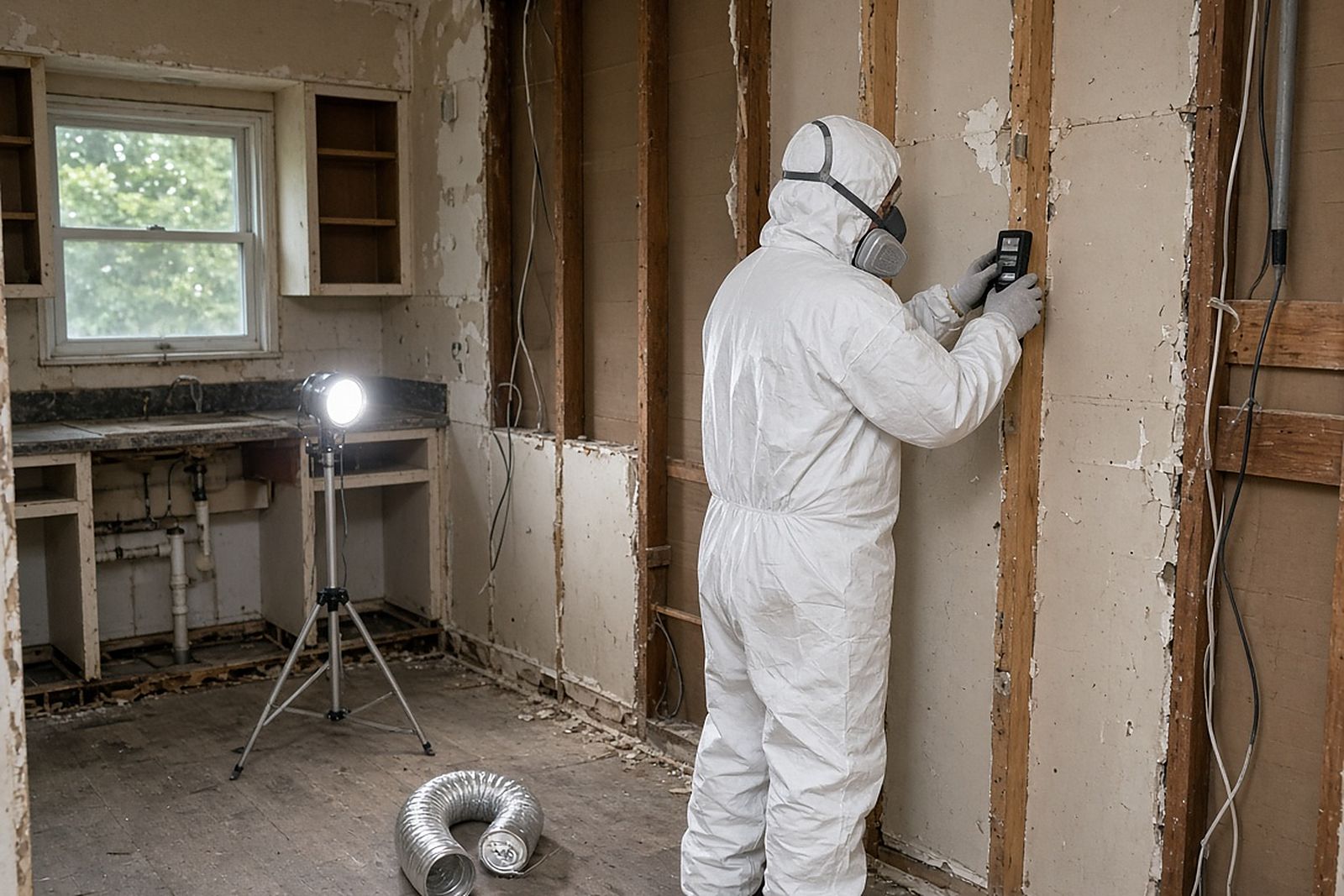
Technician in a respirator checking exposed studs in a gutted kitchen with a work light and duct
Illustrative photo, not a job record. Technician in a respirator checking exposed studs in a gutted kitchen with a work light and duct.

Meth Lab Cleanup facts the quiz draws on

2009 / 2013 / 2021

EPA's Voluntary Guidelines for Methamphetamine and Fentanyl Laboratory Cleanup were first issued in 2009, revised in 2013 and updated again in August 2021 to add fentanyl.

Read with care: The guidelines are voluntary and set no federal numeric cleanup standard.

Source: US EPA (2021)Federal guidance, United States

84% hospital-treated

Of people injured in meth-related chemical incidents, 84% were treated at a hospital, and the share of incidents causing injury rose from under 5% (2001–2007) to 10% (2008–2012).

Read with care: The rise in injury share coincided with the shift to one-pot labs, but causation was not proven.

Source: CDC MMWR (2015)Five-state surveillance, 2001–2012

63 people, 25 case studies

A study of 63 people across 25 homes contaminated by prior meth manufacture or use found behavioral, sleep, respiratory, skin and eye effects and headaches, with no difference between manufacture and use cases.

Read with care: Case series without a control group; symptoms were self-reported.

Source: Toxics (Wright et al.) (2020)Australian case series of unknowing residents

25 states; 0.05–1.5 µg/100 cm²

As of March 2013, 25 states required or recommended that former meth labs be cleaned to standards ranging from 0.05 to 1.5 µg of methamphetamine per 100 cm².

Read with care: Some states have since added or changed standards; a 30-fold range means 'clean' differs by state.

Source: Ohio Department of Health (2016)US states, per EPA 2013 summary

These figures are public research and agency data, not this network's own job records. Keep each number with its population, year and limits; none of them predicts cost, timing or outcome at a specific property.

Questions about the meth lab cleanup quiz

Is this quiz a substitute for training?

No. It measures general knowledge for owners and property managers. It does not show that someone can do a cleanup. Workers who handle lab properties need formal training, such as hazardous waste worker courses and any license their state requires. Use the quiz to prepare for hiring talks. Use it to find gaps in what you know before you make choices about a property.

Will the quiz tell me if my house is contaminated?

It cannot. Only lab testing of properly collected samples can show whether residue is present and at what level. The quiz helps you understand what testing involves and what the results mean. Then you can make sense of a report when you get one. If you think a home may be contaminated, contact a qualified inspector. Do not rely on any online tool.

Why are there questions about disclosure and landlords?

Because the legal side of a lab property often costs owners more than the cleanup itself. Not disclosing a known history, or renting the unit again before clearance, can lead to claims from later residents. The quiz includes these topics so readers see how cleanup, records, and disclosure connect. They are not separate problems.

Do the answers apply in every state?

The ideas apply broadly. But the exact limits, who may take samples, and whether a public list exists differ from place to place. Where a question touches on a rule, the quiz stays general. Always confirm the current rule with the health or environmental agency for the county where the property is. A rule from a nearby state may not apply.

Can I retake the quiz?

Yes, as often as you like. Questions may come up in a different order. Reading the study guide between tries is the fastest way to improve. No record is tied to who you are. Your score is not shared with any provider or agency. So there is no downside to taking it again.

What if I disagree with an answer?

Each explanation names the idea it is based on and links to the matching guide. You may think a question is out of date because your state changed its program. If so, use the site's contact page to let us know, and include the source. We review questions from time to time and revise them when the guidance behind them changes.

Is the quiz appropriate for tenants and buyers, not just owners?

Yes. Tenants gain from knowing what a proper clearance looks like before they sign a lease on a unit with a history. Buyers can use the ideas to judge a seller's cleanup file. Real estate agents may find the material useful for explaining risk to clients. It helps them avoid making the risk sound bigger or smaller than it is.

What other visitors think

Poll results

Every count is a real visitor vote; nothing is seeded or padded. One vote per poll per device, and you can change your answer.

Your experience

If a house you wanted had a documented lab cleanup that passed clearance, what would you most likely do?

No visitor votes yet
Industry

Which factor would you weigh most when choosing a meth cleanup contractor?

No visitor votes yet